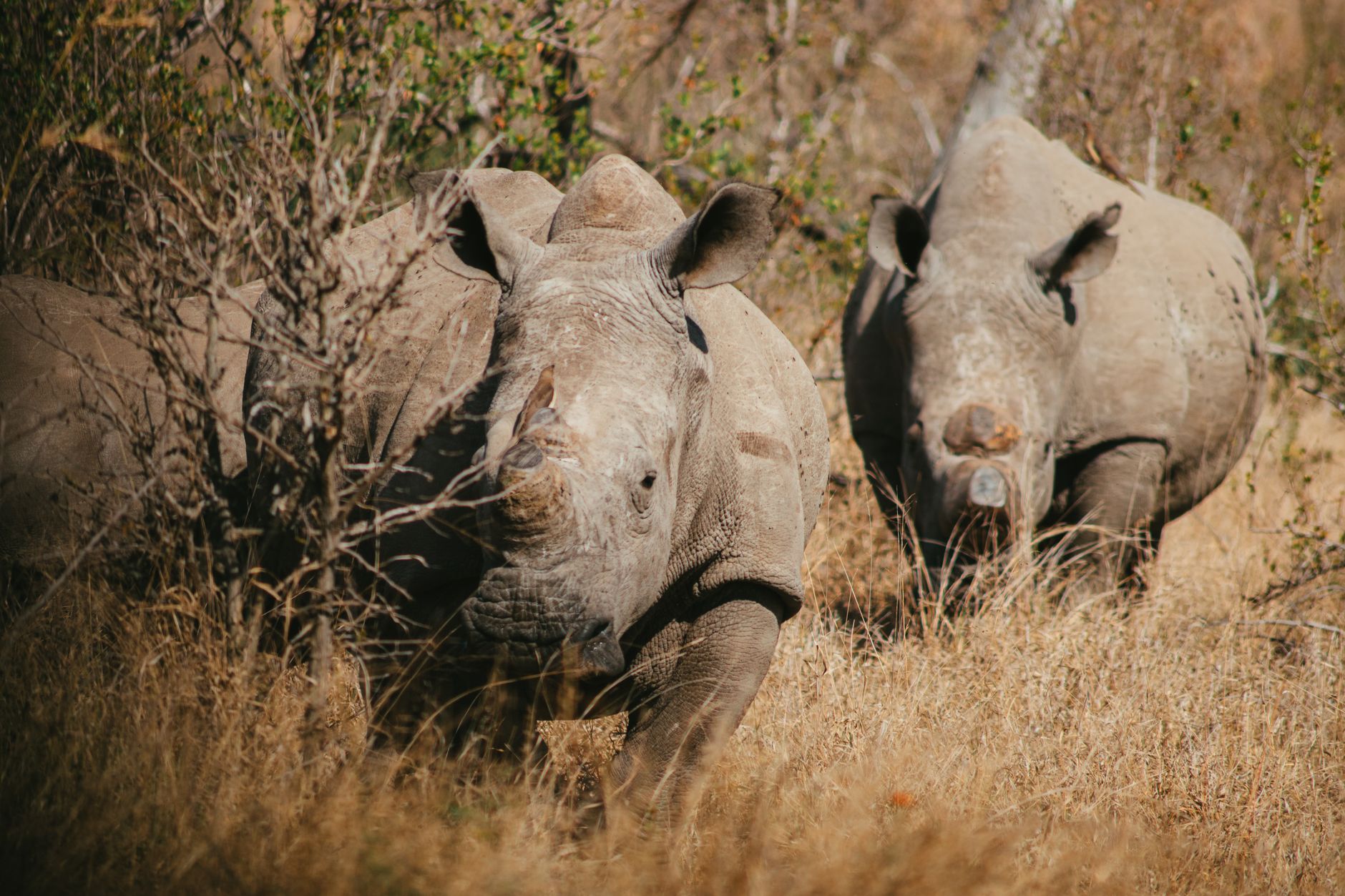
The quickest way to learn black rhino vs white rhino how to tell them apart is to start with the mouth, not the colour. Both animals are grey. The real difference is the upper lip. A white rhino has a wide, square lip for cropping grass. A black rhino has a pointed, hooked lip for pulling leaves and twigs. Keep that clue in mind and the rest of the field identification falls into place.
What Is the Fastest Black Rhino vs White Rhino How to Tell Them Apart Clue?
Look at the upper lip first. A white rhino has a broad, straight, square-shaped mouth for cropping grass. A black rhino has a pointed, hooked, prehensile lip for pulling leaves and twigs. If the face is too distant to see clearly, use the animal’s head position as a supporting clue rather than relying on colour.
Colour is nearly useless in the field. Both species are grey to grey-brown, and wallowing in mud can change how light or dark they look. The names are older than that confusion. Many accounts trace “white” to a Dutch or Afrikaans word for wide, referring to the square mouth, not to a white coat. The black rhino is not black, it just has the name.
When you are watching from a safari vehicle, do not wait for a perfect side view. Look at the mouth shape if you can, then use size and posture to confirm.
How Do Body Size, Head Position and Back Shape Compare?
White rhinos are usually larger, heavier and more barrel-shaped, with a large head held low while grazing. Black rhinos look smaller, more compact and alert, with the head carried higher. A white rhino often shows a noticeable shoulder hump, and a black rhino has a more saddle-shaped back.
| Clue | Black rhino (Diceros bicornis) | White rhino (Ceratotherium simum) |
|---|---|---|
| Upper lip | Pointed, hooked | Broad, square |
| Typical adult mass (indicative) | Roughly 900 to 1,400 kg | Roughly 1,800 to 2,500 kg |
| Head position | Usually carried higher | Usually carried lower |
| Back shape | Saddle-shaped, dipped behind shoulders | Rounded, with a shoulder hump |
| Diet | Browser: leaves, twigs, shoots | Grazer: grass |
| Usual social pattern | Mostly solitary | Sometimes in small groups |
| Common habitat | Thicket, woodland, bush | Open grassland |
| Horns | Two horns, often similar in length | Two horns, front horn usually longer |
Young animals and odd camera angles can break these patterns. A juvenile white rhino can appear slim and high-headed. An adult black rhino can look bulky if its head is down. That is why lip shape remains the primary clue.
Do Their Horns, Ears and Faces Look Different?
Both species have two horns. A white rhino commonly has a noticeably longer front horn and a shorter second horn. A black rhino’s horns are often closer in length. White rhinos generally have longer heads and more pointed ears. Black rhinos tend to have shorter faces and rounder ears. Angle, age and wear can mislead, so treat ears as a supporting clue rather than a firm rule.
Horn shape changes with age and behaviour. Rhinos rub their horns on rocks and soil, so wear can shorten them. Females and males differ too. Use horns as a supporting clue, not the test. The same applies to ears. When a rhino faces you directly, you may only see a dark, massive head. Try to move into a slight side angle with the help of your guide, and the rhino’s upper lip will come into view.
How Do Diet, Habitat and Behaviour Differ?
White rhinos are grazers associated with open grassland, and they are often seen in social groups. Black rhinos browse leaves, shoots and branches in thicker bush, and they are more often solitary. These are useful clues, not rules: either species can cross habitat, and a lone white rhino or briefly grouped black rhinos is possible.
If you are scanning black rhino habitat in Kenya, look toward acacia woodland, scrub and dense bush rather than wide grass plains. A white rhino grazing herd is easier to follow because it often stays in open country. Behaviour also differs. Black rhinos are famously alert and can charge if startled. White rhinos are usually more tolerant of vehicles when they are used to them. But every rhino is an individual, so let the lip and posture clues lead.
Rhinos are part of the Big Five in Kenya, along with lion, leopard, elephant and buffalo. If you are planning a sightings list, our Big Five Kenya guide explains what to expect from each species.
Where Can You See Black and White Rhinos in Kenya?
Ol Pejeta Conservancy is the strongest single place to see both species. Lewa Wildlife Conservancy and Nairobi National Park are known for black rhino sightings. Lake Nakuru National Park protects rhinos in fenced habitat. Visibility changes with grass height, rainfall, water availability and thick vegetation, so guides may spot movement before facial details are visible.
Ol Pejeta Conservancy in Laikipia is one of the most reliable northern destinations for seeing rhinos. It holds both species and has a well-known conservation programme. Lewa Wildlife Conservancy, also in the north, is another strong black-rhino site. Nairobi National Park is unusual because it sits near the capital and still offers a chance to see black rhino against a city skyline. Lake Nakuru National Park in the Rift Valley has fenced habitat that gives rhinos room to move while keeping them protected.
Before choosing a route, think about the difference between a northern conservancy and a reserve. For practical details, browse our Ol Pejeta Conservancy guide and our Lake Nakuru guide.
Timing matters. Grass height is lower in the dry months, so rhinos are easier to spot. After the rains, tall grass and dense bush can hide even a large animal. A good guide will point out a dark shape or a moving ear before you can see the mouth.
How Do You Identify Rhinos from Tracks and Dung?
White-rhino spoor is generally larger and may show a rounded W-like indentation at the rear of the foot pad. Black-rhino spoor is usually smaller and rounder. Dung can reinforce the identification: white-rhino dung is dominated by grass, while black-rhino dung commonly contains woody twigs, sometimes cut at a distinctive angle.
Guides call this “sign.” When a rhino has moved into thick bush, you may see footprints and droppings before you see the animal. Rhino footprints are broad and rounded, but size depends on age and soil. Do not rely on a single print, look for a pattern instead. A line of large tracks with a W-shaped back edge points to white rhino. Smaller, rounder tracks in a bushy area suggest black rhino. Dung tells you what the animal has been eating, which is a direct clue to species.
What Is the Conservation Status and How Should You View Them Responsibly?
Black and white rhinos are different species with different feeding roles. Both remain conservation priorities because poaching, habitat pressure and fragmented populations threaten them. Watch from the vehicle at the distance directed by the guide. Avoid blocking movement or separating a mother and calf, keep voices low, and never ask a driver to pursue a retreating rhino.
The IUCN lists the black rhino as Critically Endangered. The white rhino is generally listed as Near Threatened, but the northern white rhino subspecies is in a much more fragile position. Kenya holds both. Conservancies such as Ol Pejeta and Lewa use rangers, fencing, veterinary care and translocation to protect animals. Some visitors ask about buying horn souvenirs. Do not. The international trade in rhino horn is illegal, and anything sold as rhino horn almost certainly supports poaching.
Ethical viewing protects both animals and your safari experience. Stay inside the vehicle, keep the engine running only when needed, and never crowd a rhino. Mothers with calves are especially sensitive. If a guide says the animal is stressed, listen.
What Do People Often Ask About Black and White Rhinos?
Here are the questions guests ask most often on rhino drives.
How Can You Tell a Black Rhino from a White Rhino?
Check the upper lip first. White rhinos have wide, square lips for grazing, while black rhinos have pointed, hooked lips for browsing leaves and twigs. Size, head posture, habitat and social behaviour can confirm the identification when the mouth is not visible.
Are Black Rhinos Actually Black and White Rhinos Actually White?
No. Both species are generally grey to grey-brown, and their apparent colour can change after wallowing in different soils. The names are linked to historical language confusion around the white rhino’s broad or “wide” mouth, not a true black-versus-white colour difference.
Which Is Bigger, a Black Rhino or a White Rhino?
The white rhino is bigger. Adults commonly weigh roughly 1,800 to 2,500 kilograms, while black rhinos are generally much lighter, often around 900 to 1,400 kilograms. Size is helpful at a distance, but young animals and unusual viewing angles make lip shape a safer primary clue.
Do Black Rhinos and White Rhinos Have Different Horns?
Both species usually have two horns, but white rhinos often have a longer front horn and much shorter second horn. Black-rhino horns are commonly more similar in length. Horn wear, age and sex vary, so horn shape should support, not replace, the lip and posture clues.
What Is the Difference Between Black and White Rhino Footprints?
White-rhino footprints are usually larger and may have a rounded W-shaped indentation at the rear of the foot pad. Black-rhino spoor is generally smaller and rounder, though it can occasionally show a slight indentation too. Track size should therefore be interpreted alongside habitat and other signs.
How Can You Plan a Rhino Safari in Kenya?
Seeing a rhino in the wild is a moment you will remember. The next step is matching the right park, season and operator to your travel style. When you are ready, compare safari operators and browse packages through FindMySafari, Valley Safaris, or Trunktrails Safaris. They can handle the logistics, keep you safe, and make sure the viewing stays responsible.
Where Can You Find More Safari Planning Resources?
- Kenya national parks map from SafariPure
- Ol Pejeta Conservancy guide from Trunktrails Safaris
- Ol Pejeta and Sweetwaters safari package from Valley Safaris
- Big Five safari collection on FindMySafari